
Your dog doesn’t need to speak English to communicate with you. From a wagging tail to a subtle turn of the head, learning to recognise the signs can help you understand your dog better, prevent misunderstandings and build a stronger relationship.
Picture this: you’re walking your dog when another dog approaches. Its tail is wagging enthusiastically, so you assume it’s friendly. You allow the dogs to greet each other, expecting a lovely little canine friendship to begin.
Except the other dog is stiff, staring intently and holding its tail unusually high. Within seconds, the interaction becomes tense.
What happened?
The problem wasn’t necessarily that either dog was aggressive. It may simply have been that we misunderstood the communication taking place.
We’ve all heard the saying that a wagging tail means a happy dog. It’s one of those familiar beliefs that sounds sensible until you realise how much information we’re missing when we focus on the tail alone.
Dogs communicate through facial expressions, posture, movements, vocalisations and behaviour. They also respond to what’s happening around them, including the behaviour of people and other animals.
Learning to recognise these signals can help us make better decisions about when to approach, when to pause and when to give a dog some space.
After more than seven years of working with dogs as a canine behaviourist, trainer and groomer, I’ve come to appreciate how important it is to look beyond the obvious. I’m also currently studying veterinary nursing at the University of Pretoria, which continues to strengthen my interest in animal health and welfare.
One principle matters particularly to me: before labelling a dog naughty, dominant or aggressive, we should try to understand what the dog is communicating.
Let’s look at nine signals and combinations of signals that can help you do exactly that.
Table of Contents
- 1. A Wagging Tail Doesn’t Automatically Mean a Friendly Dog
- 2. Lip Licking and Yawning Can Be More Than Signs of Hunger or Tiredness
- 3. Turning the Head or Body Away Can Be a Request for Space
- 4. Watch the Eyes, Ears and Mouth
- 5. Freezing or Becoming Suddenly Still
- 6. Stiff Posture, Weight Shifts and Restricted Movement
- 7. Growling, Snarling and Barking Are Communication
- 8. Play Bows and Healthy Play
- 9. Handling, Grooming and Unfamiliar Situations
- How to Read the Whole Dog
- Common Dog Body-Language Myths
- What Should I Do When My Dog Says No?
- A Final Thought: Listen Before You Label
- References and Further Reading
1. A Wagging Tail Doesn’t Automatically Mean a Friendly Dog
Let’s start with the biggest myth.
A wagging tail tells us that a dog is experiencing some form of arousal or emotional engagement. It does not, by itself, tell us whether the dog feels happy, uncertain, frustrated, excited or comfortable with the situation.
A dog’s tail position, the speed and pattern of movement, and the rest of its body all matter.
For example, compare these two dogs.
Dog A: The whole body moves in loose, wiggly motions. The tail moves freely, the face looks relaxed, and the dog approaches in a curved, bouncy manner.
Dog B: The body is stiff, the tail is held high and moves in short, tight movements, and the dog watches the approaching person without relaxing.
Both dogs may be wagging their tails. Their overall body language, however, looks very different.
Research has found that dogs’ tail-wagging patterns can vary with emotional stimuli. Studies have also found that dogs respond differently when observing other dogs displaying different left-right tail-wagging patterns. These findings are interesting, but they do not provide a simple test for determining whether an unfamiliar dog is safe to approach. [1, 2]
What should you look for instead?
Look at the dog’s entire body:
- Is the body loose or rigid?
- Is the tail relaxed or held unusually high or low?
- Are the movements smooth and bouncy or tight and restricted?
- Is the mouth relaxed, or has it suddenly closed?
- Is the dog approaching willingly, hesitating or trying to move away?
- Does the dog remain comfortable as the other animal or person gets closer?
Real-life example: Meeting an unfamiliar dog
You’re walking in your neighbourhood when you encounter a dog on a lead. Its tail is wagging, but its body is stiff and it is staring directly at your dog.
Rather than allowing an immediate nose-to-nose greeting, create some distance and keep moving if you can do so safely.
A wagging tail is not an invitation that you must accept.
The takeaway: Never judge a dog’s friendliness by its tail alone.
2. Lip Licking and Yawning Can Be More Than Signs of Hunger or Tiredness
Dogs lick their lips for perfectly ordinary reasons. They may have food on their mouths, anticipate a treat or simply be cleaning themselves. Yawning is also normal when a dog is tired.
However, these behaviours can occur in situations involving discomfort, uncertainty or stress.
Veterinary behaviour guidance identifies lip licking and yawning among behaviours that may accompany fear or anxiety, particularly in unfamiliar or challenging situations. Research on canine behaviour during veterinary examinations has also recorded these behaviours alongside other possible indicators of fear. [3, 4]
The important word is may.
A dog that yawns once after waking up is probably not sending you a complicated emotional message. A dog that repeatedly yawns while someone leans over it, hugs it or attempts to trim its nails deserves a closer look.
The context changes how we interpret the behaviour.
Other signs worth noticing include:
- Repeated lip licking when there is no food involved.
- A tightly closed mouth after the dog was previously relaxed.
- Turning the head away while licking the lips.
- Yawning repeatedly during an interaction.
- Moving away, lowering the body or holding the ears back.
- Panting when the dog is not hot or physically exerting itself.
These signs are more informative when several occur together or represent a change from the dog’s usual behaviour.
Real-life example: Nail trimming
You’re trimming your dog’s nails. Your dog starts licking its lips, yawns repeatedly and begins pulling its paw away.
You might be tempted to assume that the dog is being difficult.
Instead, pause and assess the situation. Is the dog frightened by the clippers? Is the position uncomfortable? Could the paw be sore?
Give the dog a break rather than immediately tightening your grip and continuing.
If nail care regularly causes distress, gradual reward-based training and guidance from a qualified professional may help. Pain should also be considered, especially if the behaviour is new.
The takeaway: Lip licking and yawning are clues, not diagnoses. Look at what is happening around the dog and what other signals accompany them.
3. Turning the Head or Body Away Can Be a Request for Space
People often think a dog is being rude or ignoring them when it turns away.
Sometimes the dog is simply interested in something else. But turning the head or body away can also be a way of disengaging from an interaction.
Veterinary behaviour guidance identifies social disengagement, including turning away, among behaviours that may indicate distress in a challenging situation. The meaning still depends on the context. [3]
Imagine that you’re greeting a dog and reaching towards its head. Instead of approaching you, the dog turns its head away, shifts its body sideways and avoids eye contact.
That is a good reason to pause.
The dog may be uncomfortable with the approach, the speed of your movement or the type of contact you’re attempting.
It does not mean the dog dislikes you. It means the interaction may not be comfortable at that moment.
Real-life example: The enthusiastic visitor
A visitor arrives at your home and immediately bends over your dog to give it a big cuddle.
Your dog turns away and tries to walk towards its bed.
Instead of following the dog and trying again, let it leave. Ask your visitor to give the dog space and allow the dog to approach voluntarily if it wishes.
Not every dog wants to greet every visitor, and that’s perfectly acceptable.
The takeaway: When a dog disengages, don’t automatically try harder to get its attention. Sometimes the kindest response is to stop asking.
4. Watch the Eyes, Ears and Mouth — Especially When They Change Together
Dogs communicate through subtle changes in facial expression. Their eyes, ears, forehead, mouth and muzzle can provide useful information when considered alongside posture and movement.
One expression that often attracts attention is whale eye. This is the informal term for when a dog turns its head away or looks sideways while leaving a noticeable amount of the white of its eye visible.
Whale eye can occur when a dog is uncomfortable or concerned about something nearby. For example, a dog guarding a chew might keep its eyes on a person approaching while turning its head slightly away.
However, visible eye whites are not automatically evidence of fear or aggression. Eye shape, individual anatomy, gaze direction and the situation all matter. [5]
Other changes worth noticing include:
- Soft eyes and relaxed facial muscles: These may accompany a comfortable, relaxed dog.
- A hard, fixed stare: This can indicate intense attention or tension, especially when paired with a rigid body.
- Ears pulled back tightly: These may occur with fear or discomfort, although ear position varies with breed, anatomy and context.
- A suddenly closed, tight mouth: This can be a change worth noticing when a dog was previously relaxed.
- A wrinkled muzzle or raised lip: These can form part of a warning display and should be taken seriously.
- Repeatedly scanning the environment: This may indicate that a dog is having difficulty relaxing.
No single facial expression tells the entire story. A dog with naturally prominent eye whites, for example, should not be judged by the same visual standard as every other dog.
Real-life example: A child wants a cuddle
A child approaches the family dog and wraps both arms around its neck. The dog stays still but turns its head away. The whites of its eyes become visible, and its mouth closes.
An adult might interpret the stillness as acceptance.
A safer interpretation is that the dog may be uncomfortable and needs help ending the interaction.
Calmly guide the child away and give the dog a safe space. Teach children to interact gently and never to hug, climb on, chase or corner dogs.
Even familiar family dogs need protection from interactions they find uncomfortable. Children should always be actively supervised around dogs, with physical separation whenever an adult cannot supervise closely. [6]
The takeaway: Facial expressions become more useful when you notice changes and combine them with the dog’s posture and behaviour.
5. Freezing or Becoming Suddenly Still Is Worth Taking Seriously
A dog that suddenly stops moving can be easy to misinterpret.
You might think the dog is being obedient, waiting patiently or simply sitting quietly.
But freezing can also occur when a dog feels threatened, uncertain or unable to escape a situation.
Veterinary behaviour guidance includes immobility and freezing among possible indicators of distress. [3]
Consider the difference between a relaxed dog lying quietly on its bed and a dog that becomes rigid when someone reaches over it.
The second dog’s sudden stillness deserves attention, especially if its mouth closes, its gaze becomes fixed or its muscles appear tense.
Freezing does not guarantee that a dog will bite. Equally, it should never be treated as proof that the dog is comfortable.
A dog that cannot move away may remain still because it is unsure what to do next. If the pressure continues, it may attempt to escape, growl, snap or bite.
Real-life example: Visitors arriving at home
Your dog normally moves around the house freely. When a visitor leans over it to pat its head, the dog abruptly stops moving.
Its body stiffens, its mouth closes and it stares at the visitor.
Don’t ask the visitor to keep petting the dog to see what happens. Don’t encourage the dog to tolerate the interaction.
Instead, calmly interrupt the interaction, create space and give the dog somewhere quiet to retreat.
If visitors routinely cause this response, consider a management plan that allows your dog to relax away from the entrance and visiting guests.
The takeaway: A dog that suddenly becomes still may be communicating discomfort. Give it space rather than testing its tolerance.
6. Stiff Posture, Weight Shifts and Restricted Movement Can Reveal Tension
Dogs communicate through the way they hold and move their bodies, not just through obvious facial expressions.
A comfortable dog often moves with relatively loose, fluid movements. Depending on the situation, it may approach in a curved path, shift its weight naturally or move away without hesitation.
A dog experiencing tension may instead become stiff, lower its body, lean away, shift its weight forwards or backwards, or move in a more restricted way.
The meaning depends on the overall pattern.
For example, a forward-leaning dog with a rigid body and a fixed stare may be highly focused on something it finds challenging. A dog leaning backwards with its head lowered and tail tucked may be trying to increase distance from something worrying it.
Raised hair along the back, sometimes called piloerection, can also accompany arousal. It does not independently prove aggression: it can occur in different emotional contexts.
The key is to notice changes from the dog’s normal movement and consider what triggered them. [5, 7]
Real-life example: Two dogs meet on a walk
Your dog approaches another dog. Initially, both move loosely and investigate the surroundings.
Then one dog stops moving freely. Its body stiffens, its weight shifts forwards and its gaze becomes fixed.
This is a sensible moment to interrupt the greeting and create distance before the interaction escalates.
You do not need to wait for a growl or snap before deciding that an interaction should end.
The takeaway: Restricted movement and changes in posture are useful information, especially when they appear suddenly in response to a person, animal or object.
7. Growling, Snarling and Barking Are Communication — Not Simply Bad Behaviour
A growl can be frightening, particularly when it comes from a dog you know and love.
But growling is a form of communication. Depending on the context, a dog may growl during play, when guarding a valued item, when frightened, when uncomfortable with handling or when trying to make another individual move away.
The surrounding behaviour matters.
A loose, playful dog may make growling sounds during a game of tug. A dog guarding a bone may growl when someone approaches. A dog in pain may growl when a particular part of its body is touched.
These situations require different responses.
The important point is that a growl should never be punished simply because it makes us uncomfortable.
Veterinary behaviour organisations recommend humane, reward-based approaches to training and behaviour modification. Punishing warning displays such as growling and snarling may suppress these signals without addressing the underlying emotion, potentially making future interactions harder to assess safely. [8, 9]
If your dog growls, resist the urge to shout, scold or physically correct it.
Instead:
- Stop the interaction that appears to be causing discomfort.
- Calmly create distance without cornering the dog.
- Prevent the same situation from recurring while you work out what is happening.
- Consider whether pain, fear, resource guarding or another underlying issue may be involved.
- Seek appropriate professional guidance if the behaviour is repeated, escalating or difficult to manage safely.
Never deliberately provoke a dog to see whether it will growl. You do not need to test a warning signal to take it seriously.
Real-life example: The dog with a chew
Your dog is enjoying a chew when a child approaches and tries to take it away. The dog stiffens and growls.
The immediate priority is to move the child away and prevent further interference. Do not punish the dog for growling or allow the child to try again.
Securely manage the situation and seek qualified advice about resource guarding, especially if it is a recurring problem.
A growl does not mean that your dog is a monster. It tells you that something about the situation needs to change.
The takeaway: Respect warning signals. Your goal is not to silence communication but to understand and address the reason behind it.
8. Play Bows Are Useful Clues, but Play Still Needs Monitoring
A play bow is the familiar posture in which a dog lowers its front end while keeping its hindquarters raised.
It is widely recognised as a play signal, and research has investigated how dogs use it during social play. Studies suggest that play bows can help communicate playful intent and renew a play partner’s interest in continuing an interaction. [10, 11]
A play bow can help communicate an invitation to play, but it does not mean that every behaviour which follows will automatically remain enjoyable for both dogs.
Healthy play often includes loose, exaggerated movements, pauses, role reversals and opportunities for either dog to disengage.
For example, two dogs might chase each other around a garden, take turns being the chaser and occasionally stop before restarting the game.
That can be a good sign that the interaction remains flexible.
However, play may be becoming uncomfortable if you notice:
- One dog repeatedly trying to escape.
- One dog continually chasing or pinning the other.
- A dog hiding behind its owner or seeking an exit.
- Increasingly stiff movements or intense staring.
- Repeated attempts by one dog to disengage that the other ignores.
- A sudden shift from loose movement to rigid stillness.
- A dog becoming overwhelmed and unable to settle.
Vocalisation alone is not a reliable way to distinguish good play from bad play. Some dogs are noisy players, while others play quietly.
Instead, look at the interaction as a whole and pay attention to whether both dogs can comfortably participate and take breaks.
Real-life example: Play at the park
Two dogs begin chasing each other. At first, their movements are loose and both willingly return to the game.
A little later, one dog repeatedly tries to move away, but the other keeps chasing and blocking its path.
Even if the chasing dog appears excited, the interaction is no longer balanced.
Call your dog away if you can do so safely, give both dogs a break and allow the less interested dog to move away without being followed.
You can also briefly interrupt play to see whether both dogs voluntarily return to the interaction. Do not force them back together.
The takeaway: A play bow can signal an invitation to play, but mutual participation, relaxed movement and the freedom to disengage matter just as much.
9. Handling, Grooming and Unfamiliar Situations Can Reveal Discomfort
Some of the most important body-language signals appear during ordinary care.
A dog might tolerate brushing, nail trimming, ear cleaning or having its paws handled without actually feeling comfortable.
It may simply have learned that struggling does not change what happens next.
This is particularly important during grooming and veterinary care, where dogs sometimes need to be handled for health and welfare reasons.
Veterinary literature recommends reducing fear during examinations by using appropriate handling, allowing breaks and adjusting procedures in response to an animal’s behaviour where possible. [4, 7]
Watch for combinations of signs such as:
- Pulling away or repeatedly moving a paw out of reach.
- Lip licking or yawning when handling begins.
- Turning the head away or avoiding contact.
- Tucking the tail or lowering the body.
- Trembling, panting or attempting to hide.
- Suddenly becoming rigid or unusually still.
- Growling, snapping or trying to escape.
A dog that moves away during grooming may be worried, uncomfortable, painful or simply not accustomed to the procedure. You cannot determine the cause from body language alone.
Real-life example: The nail-trimming battle
Your dog dislikes nail trimming. Every time you reach for its paw, it pulls away. You hold the paw more firmly, and the dog begins struggling.
It can be tempting to think that you must finish the job before the dog wins.
But this can turn a difficult experience into an increasingly frightening one.
If it is safe to stop, pause the procedure. Avoid wrestling the dog into position or continuing simply to prove that you can finish.
For future sessions, a gradual plan might involve rewarding your dog for calmly seeing the clippers, then for allowing brief paw contact, and eventually for tolerating very small steps towards nail care. Progress at a pace the dog can manage.
If the dog shows signs of pain, has an unusually strong reaction or cannot be handled safely, consult your veterinarian. A veterinary professional can assess whether a medical issue needs attention and help plan appropriate care.
The takeaway: Cooperation is more valuable than forcing compliance. When a dog repeatedly struggles with handling, investigate why and make the experience safer.
How to Read the Whole Dog
By now, you may be wondering whether every tail movement, yawn or ear twitch needs a detailed investigation.
Thankfully, no!
The goal is not to become suspicious of every normal behaviour. It is to become more observant and recognise when several signals suggest that a dog may be uncomfortable.
A useful way to think about body language is to consider five things.
1. The whole body
Look at the face, ears, tail, posture, muscle tension and movement together.
2. The context
What is happening? Is someone approaching, touching, restraining or staring at the dog? Is there food, a toy, another dog or a noisy environment involved?
3. The individual dog
What is normal for this particular dog? Breed, anatomy, age, previous experiences and individual temperament can all affect how a dog behaves.
4. Changes over time
Did the dog suddenly become still, close its mouth, turn away or begin pacing? A change in behaviour can be more informative than a single isolated movement.
5. Health and comfort
Pain, illness and other physical problems can affect behaviour. A dog that suddenly becomes reluctant to be touched, irritable or withdrawn should not automatically be treated as having a training problem.
Remember that body language is evidence to help guide your response, not a mind-reading tool. We can make informed judgements about possible discomfort, but we cannot know exactly what a dog feels from one movement alone.
Common Dog Body-Language Myths
Let’s clear up a few misconceptions that can lead to misunderstandings.
Myth 1: A wagging tail always means a happy dog.
Reality: Tail movement occurs in different emotional contexts. Consider the tail’s position, movement and the dog’s overall body language.
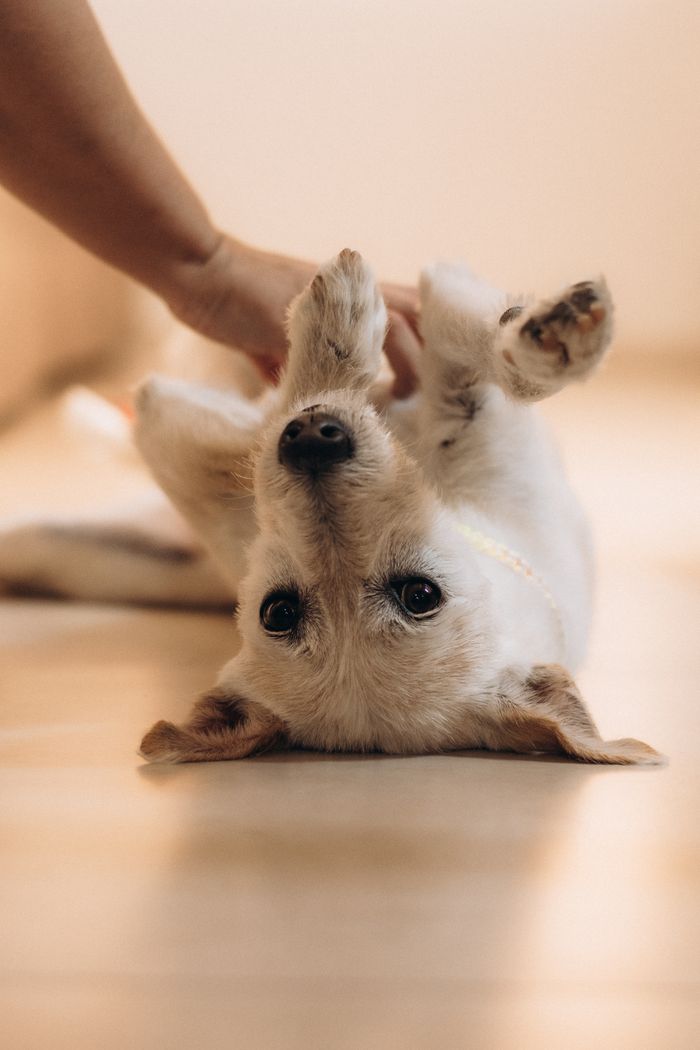
Myth 2: A dog that rolls onto its back always wants a tummy rub.
Reality: Some dogs enjoy belly rubs, but others roll over when worried or when trying to avoid confrontation. Look for relaxed movement and voluntary engagement rather than assuming the dog wants to be touched.
Myth 3: A dog that is still is a dog that is comfortable.
Reality: Freezing can be a response to fear or uncertainty. Sudden rigidity deserves attention, particularly during handling or close interactions.
Myth 4: Growling means a dog is bad or dominant.
Reality: Growling has different functions and can communicate discomfort, a desire for distance or playful engagement. Respond to the context and investigate the underlying cause rather than punishing the warning.
Myth 5: A dog that tolerates a hug enjoys being hugged.
Reality: Tolerance is not the same as enjoyment. Some dogs find close restraint uncomfortable, even when they remain still. Give dogs a choice and teach children safer ways to interact.
Myth 6: Every lip lick or yawn is a sign of stress.
Reality: Dogs lick their lips and yawn for ordinary reasons, too. These behaviours become more informative when they occur in a relevant context or alongside other changes.
Myth 7: A dog that snaps without an obvious warning is always unpredictable.
Reality: Warning signals can be subtle, easy to miss or difficult to recognise. Some situations also involve pain, intense fear or rapid escalation. This does not mean every bite is preceded by an obvious signal, but it does mean that careful observation and appropriate management matter.
The purpose of learning body language is not to blame owners for missing signals. It is to improve our ability to recognise them in the future.
What Should I Do When My Dog Says No?
When a dog appears uncomfortable, you do not need to work out its exact emotional state before taking sensible precautions.
Use this checklist:
- Pause. Stop the touching, approach or activity that may be causing discomfort.
- Create distance. Move away calmly if it is safe to do so.
- Allow an escape route. Do not corner the dog, block its retreat or force it to remain in contact.
- Avoid confrontation. Do not shout at, threaten, punish or deliberately challenge the dog.
- Look at the whole picture. Consider posture, facial expression, tail position, movement and the circumstances.
- Manage the environment. Separate dogs when necessary, supervise children actively and provide a quiet place where the dog can rest undisturbed.
- Avoid repeating the trigger to test the dog. If an interaction has caused concern, do not deliberately recreate it to see what happens.
- Consider possible pain or illness. If the behaviour is new, unusual or associated with touch sensitivity, arrange a veterinary assessment.
- Seek qualified help when needed. Repeated growling, snapping, escalating fear, resource guarding or handling difficulties deserve professional attention.
If a dog is already growling, snarling or showing marked tension, prioritise safety rather than trying to train the dog in that moment. Avoid reaching towards it or physically restraining it unless immediate action is necessary to prevent serious harm.
For ongoing behavioural concerns, speak to your veterinarian and seek an appropriately qualified behaviour professional who uses humane, evidence-based methods.
A Final Thought: Listen Before You Label
Dogs communicate with us constantly, although their messages are not always as obvious as we might like.
A wagging tail can be reassuring when the rest of the body is relaxed. A yawn can mean your dog is tired. A growl can be a warning that something needs to change. A play bow can invite another dog to join in.
The trick is learning to look at the whole dog rather than relying on one familiar signal.
The more we understand canine body language, the better we can recognise discomfort, prevent misunderstandings and create situations in which our dogs feel safe enough to learn and interact confidently.
And perhaps most importantly, we can stop assuming that every difficult behaviour is simply a dog being naughty.
Your challenge this week: Spend a little time observing your dog during an ordinary walk, a grooming session or a quiet moment at home. Notice how its face, posture, tail and movement change with the situation. Give it space when it needs it, and let it choose when to engage.
If you notice a sudden behavioural change or are concerned about your dog’s comfort or safety, speak to your veterinarian or an appropriately qualified behaviour professional.
At Carla’s Clever Canines, I believe better understanding starts with paying attention. The more carefully we learn to listen to our dogs, the better we can care for them.
References and Further Reading
- Quaranta, A., Siniscalchi, M. and Vallortigara, G. (2007). Asymmetric tail-wagging responses by dogs to different emotive stimuli. Current Biology, 17(6), R199–R201. Read the study on PubMed.
- Siniscalchi, M., Lusito, R., Vallortigara, G. and Quaranta, A. (2013). Seeing left- or right-asymmetric tail wagging produces different emotional responses in dogs. Current Biology, 23(22), 2279–2282. Read the study on PubMed.
- American Veterinary Society of Animal Behavior (AVSAB). Understanding Canine Facial Expressions and Body Postures. Read the professional guidance.
- Minimising Stress for Patients in the Veterinary Hospital: Why It Is Important and What Can Be Done about It. (2017). Veterinary behaviour and clinical handling review. Read the article on PubMed Central.
Disclaimer: This article provides general educational information about canine behaviour. Body language cannot establish a dog’s emotional state or guarantee that an interaction is safe. Consult a veterinarian about possible pain, illness or sudden behavioural changes, and seek appropriately qualified behavioural support for ongoing concerns.